

A mid-sized industrial distributor goes live with AI CRM software in January. By June, the CFO asks a simple question: what has it returned? The sales head shares usage reports. Every rep logs in daily. Thousands of leads have been scored. The CFO isn't convinced. Logins don't pay salaries.
This gap is common. CRM analytics closes that gap. It connects what happens inside the CRM to the outcomes leadership cares about: revenue, margin, retention, and cost to serve. The right CRM makes that link visible, with built-in dashboards, BI reporting, and predictive insights that tie daily activity to those outcomes.
This article covers which metrics matter, where AI changes what you can measure, and how to build a measurement plan that holds up in a board review.
Why Usage Reports Fall Short
Adoption is a starting point, not a result. A CRM can be fully adopted and still change nothing. Reps may log calls without improving conversion. Managers may open dashboards without acting on them.
AI raises the stakes. Lead scoring, forecasting, and automated follow-ups promise better decisions. But a prediction creates value only when someone acts on it and the outcome improves. Measure the prediction alone, and you are measuring activity, not impact.
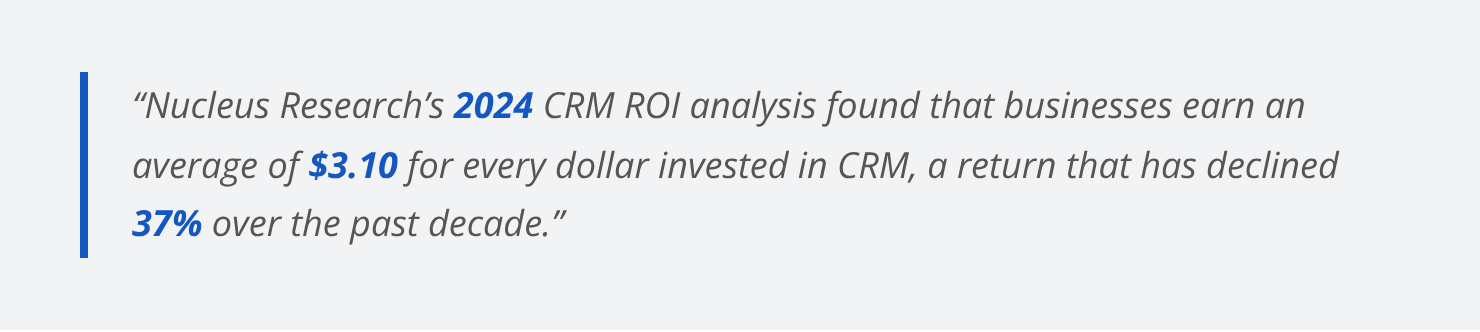
Industry data points in one direction. Your own numbers need to confirm it for your business.
The Three Levels of CRM Performance Metrics
Strong measurement works across three levels. Each answers a different question, and each needs a different owner.
- Adoption: Is the team using the system? Track active users, data completeness, and activities logged. Owned by the CRM admin.
- Operational: Is work getting faster or better? Track lead response time, sales cycle length, and first-contact resolution. Owned by sales and service managers.
- Business outcome: Is the company performing better? Track win rate, revenue per rep, retention rate, and cost to serve. Owned by the CFO and leadership.
The real story sits at the third. The middle level explains why the outcomes moved.
Where AI Changes What You Can Measure
Traditional CRM reporting looks backward. It tells you what closed last quarter. AI adds a forward view: which deals are at risk, which customers may leave, and where the pipeline is likely to land. That opens up new metrics worth tracking.

Sales Analytics: Forecast Accuracy and Deal Velocity
Sales analytics software can now compare predicted outcomes with actual ones. Forecast accuracy becomes measurable: how close was the AI-supported forecast to the final number, quarter after quarter? Deal velocity shows whether opportunities move through stages faster once sales automation software handles follow-ups and reminders.
Track win rate by lead score band as well. If high-scored leads don't convert at a higher rate, the scoring model may need tuning, or the team may not be prioritizing them as intended.
Customer Analytics for Retention and Lifetime Value
Customer analytics shifts attention from new deals to existing accounts, where most profit lives. Useful customer retention metrics include:
- Retention rate by segment and account size
- Time between purchases for repeat buyers
- Share of at-risk accounts flagged early and then saved
- Customer lifetime value against acquisition cost
The third metric is where AI earns its keep.
Service Analytics: Resolution and Escalation
Service data often carries the earliest warning signs. Measure first-contact resolution, average resolution time, and repeat tickets per account. When service history sits alongside sales data, a rising ticket count on a key account becomes a renewal risk the account manager can see in time to act.
Explore Focus CRM
Focus CRM unifies sales, marketing, and service data with AI insights, forecasting, and real-time BI reporting.
How to Build a CRM ROI Measurement Plan
CRM ROI is rarely disputed because of the math. It is disputed because nobody agrees on the starting point. These steps fix that.
1. Record a baseline before go-live
Capture win rate, cycle length, response time, and retention for at least two quarters before rollout. Without a baseline, every improvement is an opinion.
2. Link each metric to one business goal
Choose five to seven metrics that map to targets leadership already tracks. If a metric doesn't connect to one of those targets, keep it out of the executive view.
3. Isolate the effect of AI
Run AI features with one team or region first, and compare results against a group working without them. This separates AI impact from seasonal swings and process changes.
4. Count time recovered, not just revenue gained
Hours saved on data entry, reporting, and follow-ups are part of the return. Convert them into capacity: more customer meetings, faster quotes, less overtime.
5. Review on a fixed cadence
Review operational metrics monthly and business outcomes quarterly. Retire metrics nobody acts on, and add new ones as AI features expand.
Conclusion
An AI-powered CRM is an investment, and leadership will judge it like one. The value is real only when it shows up in numbers the finance team trusts.
Our CRM solution can turn customer data into measurable results. Fill in the form to book your free demo.