What happens when your factory knows everything, but nobody can act on it?
A modern production facility generates a constant stream of information. A machine records a change in performance. A supplier updates a delivery schedule. A production line falls slightly behind target.
Individually, these events may not seem urgent. Together, they can affect production timelines, material availability, and customer commitments.
The difficulty is that many teams still discover problems after they have already impacted the factory floor. Yesterday’s reports explain what went wrong. They rarely help a production manager decide what needs attention right now.
Connected ERP systems supported by AI can recognize patterns across operational data, helping teams identify potential bottlenecks, adjust schedules, and respond before small issues become larger production problems.
Visibility is important. Understanding the impact is what matters.
For years, manufacturers invested heavily in digital systems to improve visibility across their operations. But seeing a problem is only the first step.
A delayed shipment, for example, is not only a procurement concern. It can affect production schedules, workforce planning, inventory availability, and customer delivery dates.
This is where smart factory ERP solutions are changing expectations. Instead of presenting isolated information from different departments, they provide a connected understanding of how one event influences the rest of the manufacturing process.
The shift is subtle but significant: from reporting what happened to helping teams determine what should happen next.
Why are manufacturers reconsidering how they maintain their equipment?
A machine breakdown rarely affects only one machine.
It can interrupt an entire production schedule, create unexpected maintenance expenses, and force teams to reorganize resources with little warning.
Traditional maintenance often follows a calendar. Equipment is inspected after a fixed number of hours or repaired when it fails. The problem is that machinery does not always follow a schedule.
A predictive maintenance ERP uses historical performance, operating conditions, and equipment behavior to identify early signs that something may be changing.
A maintenance team that receives a warning a few days before a failure has options. A team that discovers the issue after production stops has fewer choices.
The next stage of automation is not about replacing people
Automation has been part of manufacturing for decades. Machines have long handled repetitive tasks with accuracy and consistency.
What is changing is the role of software.
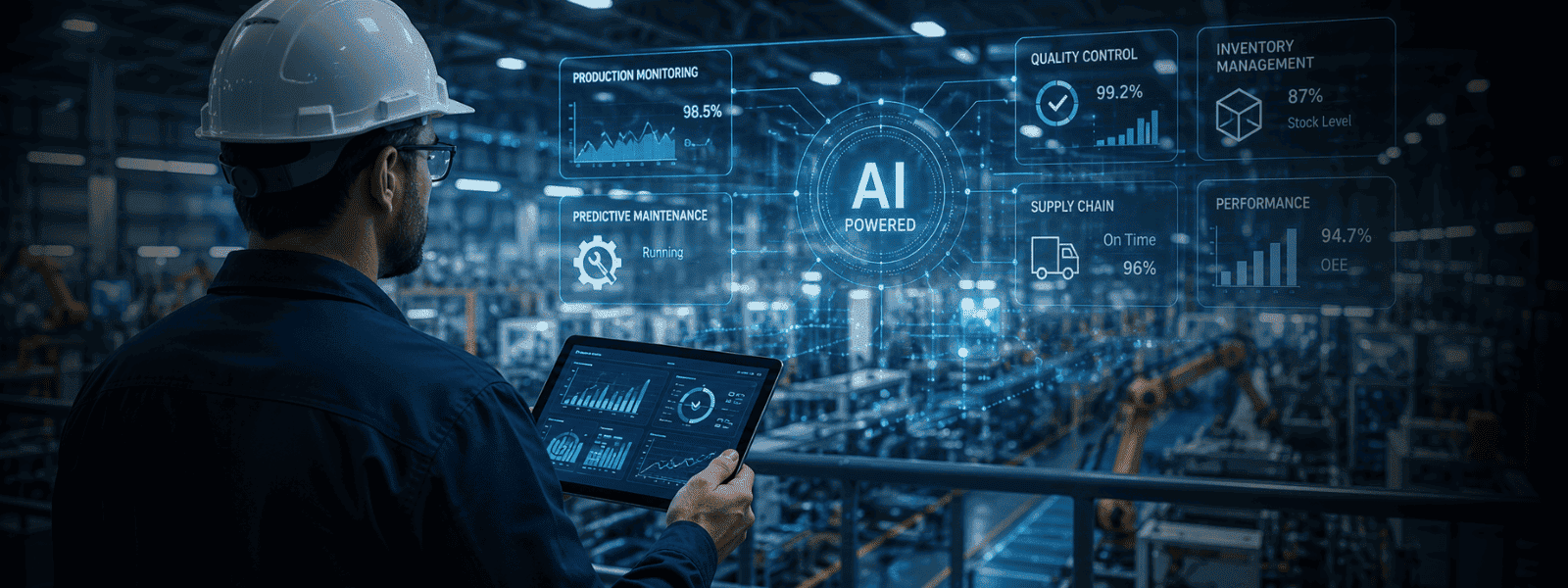
with factory floor automation AI, systems can monitor ongoing operations, detect unusual conditions, and bring important issues to the attention of supervisors. The decision still belongs to people. The difference is that they have clearer information at the moment they need it, rather than after a problem has already affected output.
Why AI-Driven Manufacturing Innovation depends on connected operations
Artificial intelligence is often discussed as the next major transformation in manufacturing. Yet, its effectiveness depends on something much more fundamental: the quality and accessibility of operational data.
An AI model cannot identify patterns across production, inventory, maintenance, and procurement if those functions operate in separate systems.
This is why AI-driven manufacturing innovation begins with connected processes and a reliable flow of information between departments.
The manufacturers that make the greatest progress will not necessarily be those that adopt the most advanced technology first. They will be those that create environments where information moves quickly, decisions are made with context, and teams can respond before disruptions spread.